A building can protect us from heat, rain and pollution and still create an unhealthy environment inside. We often think about habitat as something outside the walls of a building: housing, neighborhoods, green spaces, clean water and safe streets. But for millions of people who spend eight or more hours a day in offices, hospitals, schools, malls and other commercial buildings, the building itself is part of their everyday habitat.
That makes indoor environmental health a much bigger issue than ventilation or air-conditioning alone. The products used to clean the building, the way washrooms are designed, the chemicals that enter wastewater, and the quality of the air people breathe all contribute to the experience of that habitat.
On World Habitat Day, the conversation about healthier places should therefore extend beyond how a building looks or how efficiently it uses energy. It should also ask a more practical question: Is the building designed to support the health and comfort of the people who spend their day inside it?
A Healthy Habitat Does Not End at the Entrance
Modern commercial buildings are increasingly designed around sustainability. Energy-efficient lighting, efficient HVAC systems, water-saving fixtures, waste segregation and green-building certifications have become important parts of building design. These improvements matter. But sustainability and health cannot be treated as separate objectives.
A building may save electricity while using highly fragranced cleaning chemicals every day. It may conserve water while allowing persistent washroom odor to become a maintenance problem. It may have sophisticated wastewater infrastructure while the cleaning products entering that system are rarely considered part of the building’s environmental performance.
The healthiest buildings need to look at these systems together. This is particularly important because indoor environments are where people spend a significant part of their working lives.
The Chemistry of a Clean Office
Walk into a freshly cleaned office or washroom and there is often an immediate signal that the cleaning has been done: the smell of the cleaning product. For years, a strong chemical or fragrance smell has been associated with cleanliness. But smelling alone is not evidence of hygiene.
Cleaning products can contain volatile organic compounds, solvents, fragrances, and other ingredients that contribute to indoor chemical exposure. The actual risk depends on the formulation, concentration, ventilation, frequency of use and exposure conditions, so it is important not to treat every cleaning product as equally harmful.
The larger point is that the chemistry used to clean an indoor environment becomes part of that indoor environment. In a large commercial building, cleaning does not happen once a week. Washrooms, corridors, floors, kitchens, and common areas may be cleaned several times a day.
Housekeeping employees can have repeated occupational exposure, while other occupants encounter the residual environment after cleaning. This makes product selection a building-health decision as well as a housekeeping decision.
Clean Should Not Have to Mean Strong-Smelling
There is a useful distinction between removing a source of contamination and masking its smell. A heavily fragranced air freshener can make an area smell different. It does not necessarily solve the reason the unpleasant odor appeared in the first place.
The same principle applies to washrooms. If urine odor is persistent, continuously adding fragrance may only layer one smell over another. A better approach is to look at the source, drainage, ventilation, cleaning routine and fixture design. This is where building health becomes connected to facility management. The objective should not be to make a washroom smell like a cleaning product. The objective should be to make the washroom clean, functional and comfortable without unnecessary chemical intensity.
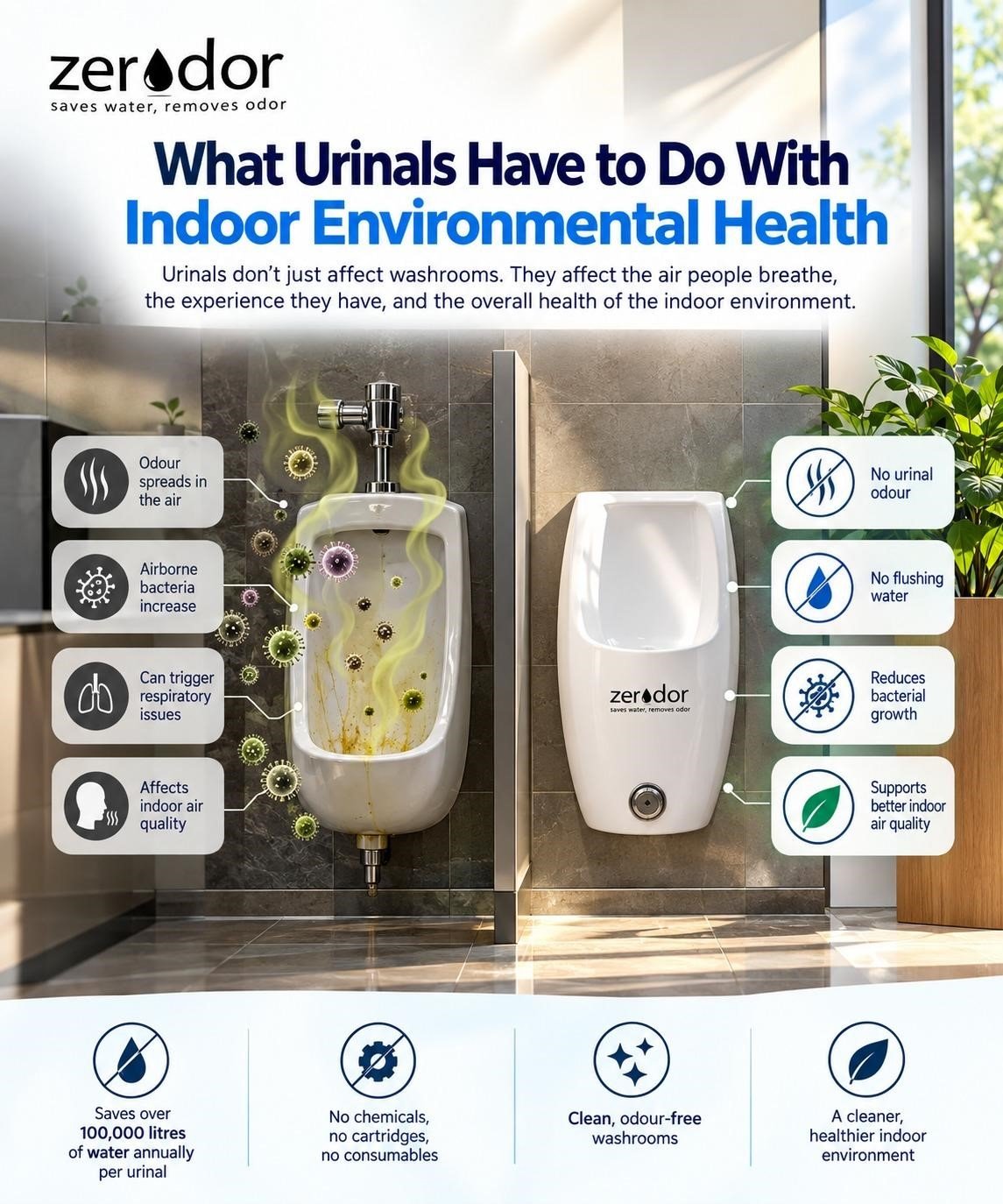
What Urinals Have to Do With Indoor Environmental Health
The connection between urinals and indoor health is not immediately obvious. It starts with ammonia.
When urine is allowed to break down, ammonia can contribute to the characteristic sharp odor associated with poorly managed washrooms. In an enclosed space, persistent odor affects the perceived quality of the environment and can indicate that the underlying sanitation system needs attention.
Traditional flush-based urinals address urine removal by using water. Waterless urinals take a different approach. Instead of repeatedly flushing potable water through the fixture, a properly designed waterless urinal allows urine to drain while using a sealing mechanism to help prevent sewer gases from returning through the drainage system.
Zerodor, developed by Ekam Eco Solutions, uses a mechanical valve for this purpose. The valve allows liquid to pass while helping block gas backflow. The result is a sanitation system that does not depend on flushing water, electricity or sensor-operated flushing. That makes waterless sanitation relevant not only to water conservation, but also to washroom design and everyday facility management.
Water Efficiency and Health Can Work Together
It is sometimes assumed that using more water automatically creates a cleaner restroom. That is not necessarily true. Hygiene depends on cleaning, drainage, fixture design, maintenance, and user behavior. A flush is a mechanism for moving waste; it is not, by itself, a guarantee of hygiene. For commercial buildings, eliminating unnecessary flushing can significantly reduce water consumption.
Zerodor estimates savings of approximately 1.5 lakh liters of water per urinal per year, depending on usage and the existing flushing system. On scale, the numbers become meaningful. Ten urinals could represent approximately 15 lakh liters of potential annual water savings under the stated usage assumptions.
That water does not need to be treated, pumped and sent down the drain simply to move urine from a fixture. For a facility manager, this is a resource-efficiency decision. For a sustainability team, it is a water-management opportunity. For an architect, it is a design consideration. And for the people using the washroom, it can simply mean a better-functioning facility.
Cleaning Products Also Travel Beyond the Room
There is another connection that is easy to overlook. The cleaning product used in a washroom does not disappear when the housekeeping team finishes the job. It can enter the drainage system. This means the cleaning strategy of a building is connected to its wastewater strategy.
Commercial buildings with sewage treatment plants have an additional reason to examine what enters their wastewater stream. Cleaning chemicals, disinfectants, and other substances can interact with biological wastewater-treatment processes depending on their formulation and concentration.
This does not mean every conventional cleaning product will damage an STP. It means facility teams should understand what they are putting into the system rather than treating housekeeping and wastewater management as completely unrelated functions.
A Different Approach to Commercial Cleaning
At Ekam Eco Solutions, we have approached this problem by developing Zerodor Care, a range of cleaning products designed around plant-based and bio-enzyme formulations.
The range includes products for floors, toilets, drains, kitchens, hands and multipurpose cleaning. Zerodor care The purpose is not to suggest that every chemical product is inherently unsafe, or that natural automatically means better in every application.
The more useful question is whether a building can achieve the required cleaning performance while reducing unnecessary chemical exposure, packaging, and environmental load. For frequently cleaned commercial spaces, that distinction matters. A cleaning program should be designed around the actual cleaning requirement rather than the assumption that stronger smell or stronger chemistry automatically means better results.
The People Behind the Cleaning Are Part of the Habitat Too
When we talk about healthy buildings, the conversation often focuses on occupants. Housekeeping teams deserve equal attention. They are the people who handle cleaning products, dilute formulations, clean enclosed washrooms, deal with drains, and spend hours working in spaces where chemicals are routinely used.
For them, product selection is not an abstract sustainability issue. It is part of their working environment. A responsible facility strategy therefore needs to consider the people who maintain the building, not only the people who occupy it. This is one reason environmental health needs to become part of everyday facility management rather than remaining in a specialist discussion reserved for building certifications.
Green Certification Is Not the Finish Line
Green-building frameworks have helped move the industry toward better water, energy and resource efficiency. But certification should be viewed as a starting point for better building performance, not the end of the conversation. A building’s environmental performance changes every day according to how it is operated.
A beautifully designed building can still have poor cleaning practices. A water-efficient building can still waste water in specific areas. A building with excellent ventilation can still introduce unnecessary chemical pollutants through poor product selection. And a sustainable building can still have an uncomfortable restroom. The real test of a healthy habitat is what people experience when they use the building every day.
What Should Facility Managers Measure?
A healthier building does not have to begin with a major capital project. It can begin with measurement. Facility teams can start by tracking cleaning-product consumption, dilution practices, recurring odor complaints, washroom maintenance calls, water consumed by flushing, wastewater-treatment observations and feedback from housekeeping teams.
Indoor air-quality monitoring can also help buildings understand conditions rather than relying solely on perception. The goal is not to create another complicated checklist. It is to identify where the building is creating avoidable exposure, resource consumption or maintenance problems. Once those points are visible, solutions become easier to evaluate.
World Habitat Day Is a Reminder to Look Inside
A healthy habitat is not simply a roof over someone’s head. It is the combination of infrastructure, environment, sanitation, resources and human experience that makes a place genuinely workable. For commercial buildings, that means looking beyond the façade.
Look at the washroom.
Look at the cleaning products.
Look at what enters the drain.
Look at the water used for flushing.
Look at the people who clean the building.
Look at the air people breathe after the cleaning is finished